
Featured

A child's art that says "I want to go home" with a house and a person crying and words in Spanish

God’s Children: A Haggadah Supplement for Immigrant Justice

Through this new haggadah supplement from T’ruah, bring the fight for immigration justice into your seder.  

The Other Side of the River, the Other Side of the Sea

T'ruah's haggadah helps transform the seder into a conversation about immigration, racism, workers' rights, and forced labor.

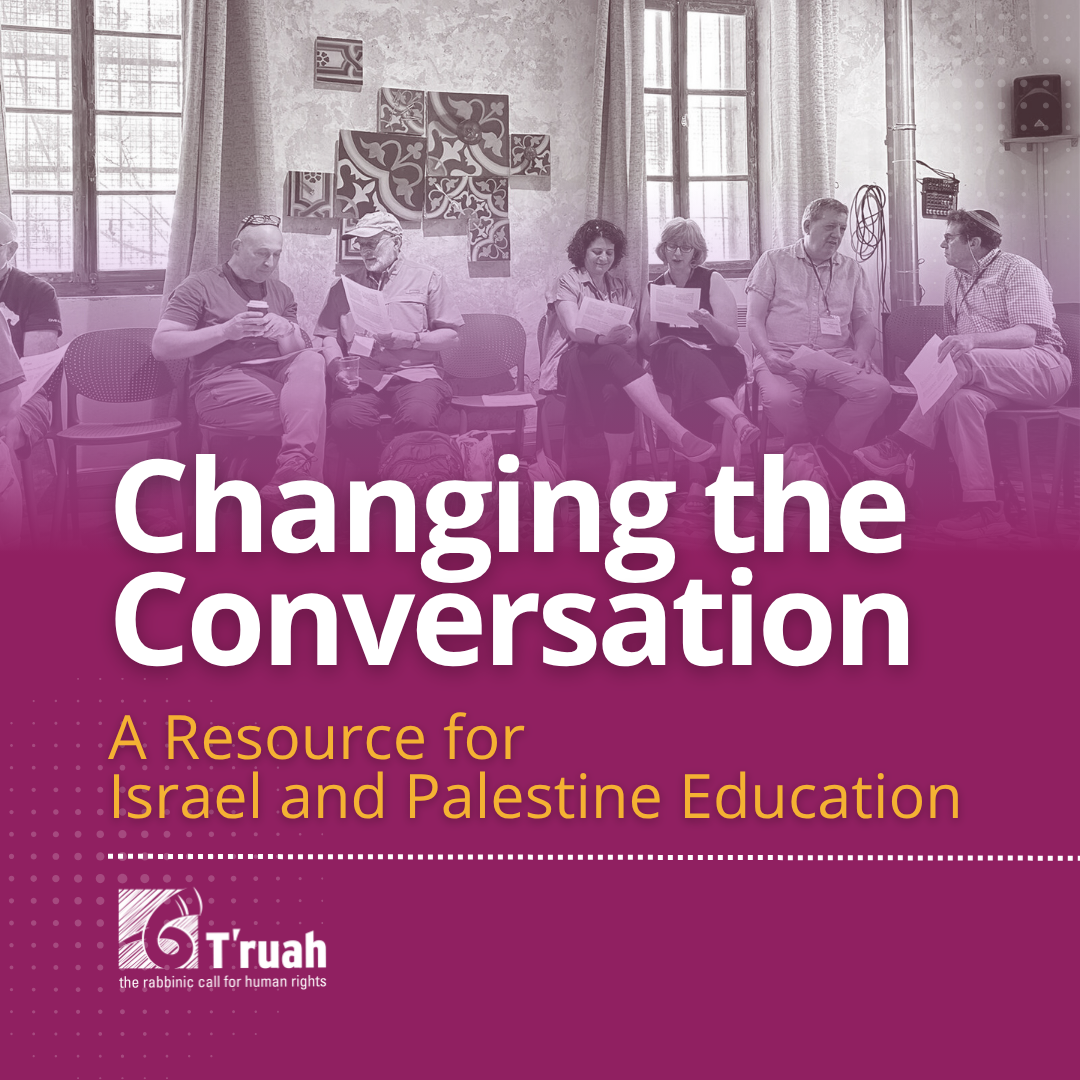
Yom HaAtzma’ut: A Resource for Educators

This resource has been created ahead of Yom HaAtzma’ut 2025 but is designed to be adaptable for year-round use, offering educational tools, programs, and texts that support ongoing learning within your community.

Search Resources

Wrestling With Our Fear (Parshat Vayishlach)

by Rabbi Rachel Silverman
Commentary on Parshat Vayishlach (Genesis 32:4 – 36:43) Alone. Anxious. Curled in the fetal position, recalling and recoiling from the memories of a similar night years before. Scared of what tomorrow might bring. Sure, this sounds like how many of us spent election night. But it is also how we imagine Jacob’s fitful night before...
more

The Binary Brothers (Parshat Toldot)

by Cantor Sherri Allen
Commentary on Parshat Toldot (Genesis 25:19 – 28:9) This week’s Torah portion, Toldot, tells the story of twin brothers who were labeled from the moment they were born, and the consequences have reverberated throughout our history. Jacob, the heel-grabbing younger brother who tried to prevent his sibling from emerging from the womb first was the...
more

Is Three a Magic Number? (Parshat Vayera)

by Rabbi Daniel Bronstein
Commentary on Parshat Vayera (Genesis 18:1 – 22:24) This edition of Torah from Truah is sponsored by Dale Gardner in memory of her sister Rhonda Kolarik. “Three is a magic number.” One can surely ascribe meaning to almost any number or any letter of the alphabet. But let’s consider the number three for a moment....
more

Not There Yet (Parshat Lech Lecha)

by Rabbi Nancy Kasten
Commentary on Parshat Lech Lecha (Genesis 12:1 – 17:27) Our third and youngest child started college this fall. She left her city, her birthplace, and the only house she has lived in. At least once a day, someone asks me, “How’s the empty nest?” The answer is complicated, because I’m not in the nest anymore...
more

All God’s Creatures Great and Small (Parshat Noach)

by Rabbi Lori D. Shaller
The dominion over animals given to humans in Genesis 1:27, compared with the rabbis’ notion that humans were created equal to the rest of creation, is an example of God’s and our own ambivalence about being the stewards of every other plant and animal species. Noah’s care of the animals, taken in light of permission to eat them, seems to suggest that he owns them and can do what he wants with them. We, like God and our Sages, seem also to be ambivalent about our role as stewards of the rest of creation.
more

Unetaneh Tokef: Rising to Deal with Uncertainty and Change (Parshat Ha’Azinu)

by Rabbi Cheryl Weiner
The question is not “who will live and who will die?” because we are all mortal creatures: “our origin is dust and dust is our end.” Rather, in this specific year ahead, what kinds of transience will we experience, and how will we weather it?
more

The Human Right to Have a Child

by Rabbi Idit Solomon
Commentary on Rosh Hashanah Torah and Haftarah readings. Reproductive rights have been hijacked. When someone mentions the phrase “reproductive rights,” the first things that usually come to mind are either birth control or abortion. However, the ability to prevent pregnancy is only part of reproductive rights. What about the right to have a child? This...
more

Justice and Compassion (Parshat Shoftim)

by Rabbi Nelly Altenburger
Commentary on Parshat Shoftim (Deuteronomy 16:18 – 21:9) Parshat Shoftim opens with the injunction of setting judges and officers within your gates (Deut. 16:18). The proximity of Parshat Shoftim to the month of Elul has given way to an interesting inner connection, brought by several Hasidic masters (Avodat Israel, Devarim, Shoftim 1 ; Sefat Emet,...
more

Those who served their time deserve a second chance (Shabbat Nachamu)

by Rabbi Edward C. Bernstein
A d’var Torah on Shabbat Nachamu Clarence Office, Jr., of Miami, FL, served in the U.S. Army for three years in the 1970s and was honorably discharged. Like many veterans, Clarence tragically fell into drug use and was arrested for drug offenses. He served a prison term and paid his debt to society. Clarence now...
more

The Weeping Mother Speaks: On Tisha B’Av, Remembering the Pain of Separation

by Rabbi Ruhi Sophia Motzkin Rubenstein
Tisha B’Av reminds us: You know what this awful pain feels like. First, every year, we are supposed to practice feeling the excruciating dissonance between the way things are and the way they should be. We have to feel the deep outrage and pain of the crying mother. But we must also be Rachel, weeping not only for her children, but naming the more compassionate way of being that we know, that we remember is possible.
more

Sign up for updates and action alerts