
Resources
Featured

Antisemitism & Immigration: A Messaging Guide for Jewish Clergy
When the fight against antisemitism is used to harm immigrants, rabbis and cantors can be powerful voices to describe what’s at play and advocate for and inspire action towards our shared safety.

T’ruah: 2026 Poll Worker Recruitment Toolkit
Our toolkit enables you to recruit people in your community to sign up to become a poll worker.
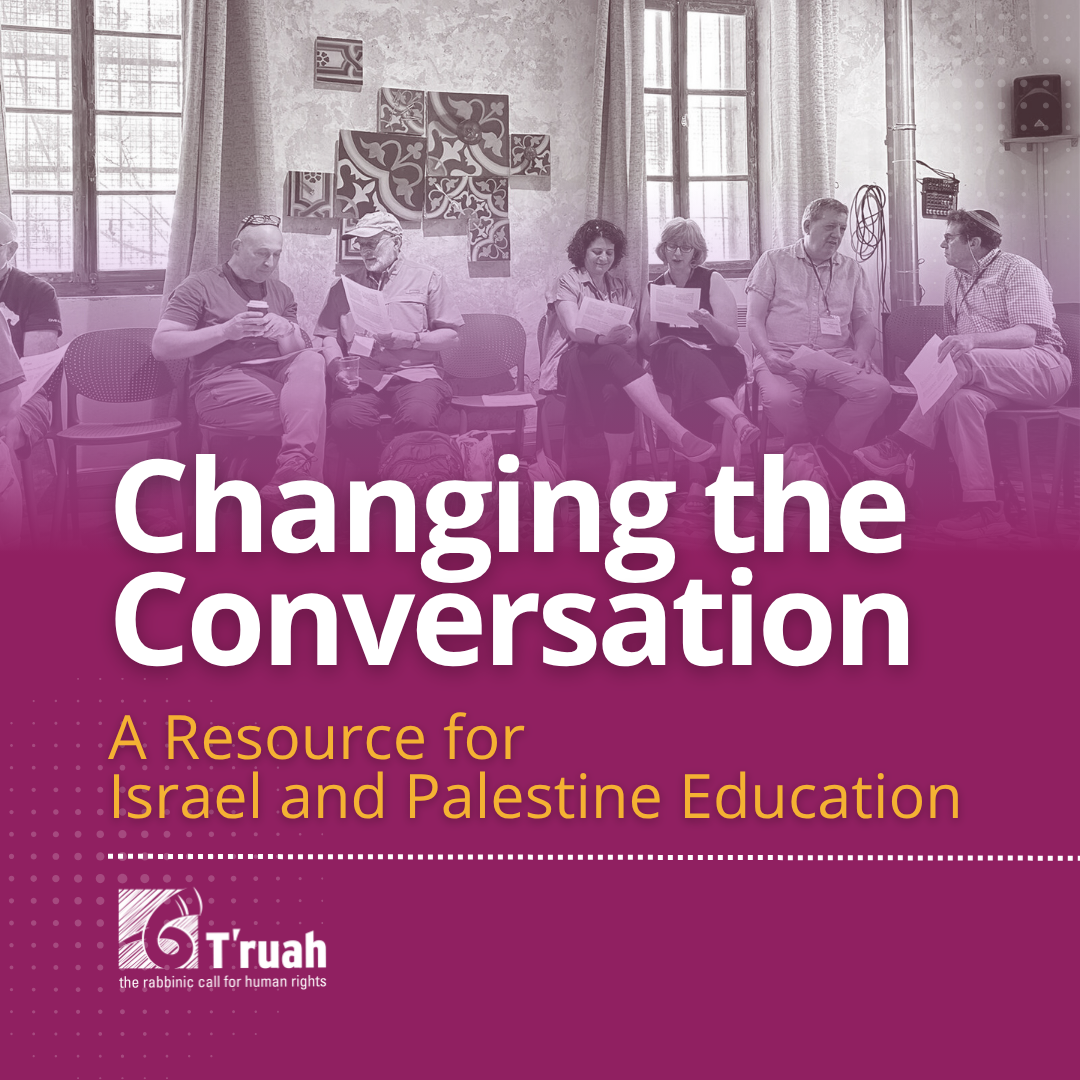
Download Changing the Conversation: A Resource for Israel and Palestine Education
An entry point for Jewish communities to engage with Israel and Palestine with depth, nuance, and care.



Misheberach for Hunger Strikers
May the One who blessed our ancestors Abraham, Isaac, and Jacob, Sarah, Rebecca, Rachel, and Leah— Who was with our brother Joseph in the pit and in prison, and with Miriam when she was isolated from the camp for seven days— bless and heal all those who are engaged in hunger strikes against torture and...
more

Envisioning a Just Society
In parshat Ki Tetze we encounter the case of the ben sorer u’moreh, the wayward and rebellious son. We read in Devarim 21:18-21 that if a child does not obey his mother and father they should bring him out to the gates of the city before a council of elders, publicly declare him a glutton...
more

Balak and Solitary: Dealing With Our Desire To Curse Those Who Harm Us
"In this reorientation from one way of doing things to a better one lies the relevance, power, and teaching for our broken criminal justice system today."
more

Sent Out of the Camp
This week’s parashah deals with a somewhat puzzling disease, called tzara’at, often translated as “leprosy.” As the Torah describes it, it’s an affliction that could appear on human skin, on clothes, or even infect houses. It’s not clear if the affliction is truly physical, as Leviticus seems to indicate, or if it’s a physical manifestation of...
more

The Heart of the Torah
We often point to Kedoshim, The Holiness Code (Lev. 19 & 20), as containing the heart of the Torah, the mitzvah to Love your neighbor as yourself (Lev. 19:18). Having recently retold the story of our liberation from oppression in Egypt at our Pesach seders, we might reconsider and look to Leviticus 19:33-34 as the...
more

Does the Punishment Fit the Crime?
As my 8 month old son becomes more mobile and is more interested in engaging with his 2 ½ year old sister, the discussions about pushing and hitting have ramped up in my house. What’s most frustrating is that I know my daughter loves my son. She wakes up every morning wanting to know where...
more

What I Learned In Prison
About three years ago, I was called by the Head Chaplain of the Butner Federal Correction Institution located forty-five minutes north of my home in Raleigh, NC. This is the same penitentiary where (in)famous prisoners like Jonathan Pollard and Bernard Madoff currently reside. The chaplain’s message came with a southern drawl: “Rabbi, we have a...
more

Peering Outside the Camp
“Joseph’s master had him put in prison…but even while he was there in prison, God was with Joseph.” -Genesis 39:20-21 Bulletproof glass separates me and my congregant. David [not his real name] and I sit opposite one another, in identical, soundproof, cinder-block visiting cubicles at a prison an hour’s drive from my home. He’s wearing...
more

How can a grasshopper change the world?
In the struggle for human rights, it is hard not to feel like a tiny grasshopper scratching at the massive walls of injustice we face all around us. There are so many people who are suffering, so many systems that are deeply broken; there is so much work to do. In parshat Shlach Lecha, God...
more

Joseph’s Jailor and Gideon’s Trumpet: The Scourge of Wrongful Conviction
The Biblical Joseph evokes the dreamer, technicolor coat, and predictions that saved Egypt from famine. Less often recalled is the Joseph who rotted in jail for a crime he didn’t commit. Joseph’s slavemaster Potiphar summarily incarcerated Joseph based on the lie of Potiphar’s wife that Joseph had come on to her when, in fact, Joseph...
more