This week, in Parshat Bo, the plague of darkness has enveloped all of Egypt. A darkness that, as the commentator Sforno writes, was not “merely the absence of light [that] could be dispelled by kindling a fire…this was ‘an opaque darkness’… nothing could penetrate it.” It was a darkness that could be grasped, felt in the hand. The descriptions are vivid. We are told that people could not see one another, not even the person sitting right next to them. It was a darkness more intense than any night sky.
This was true for the Egyptians, at least. Their short-sightedness towards their slaves manifested itself in a blindness of sorts. Darkness, in Bo, was not merely the absence of light, but the collapse of moral vision — the inability to see the person beside you.
The Israelites, by contrast, were granted some respite in this moment. “But all of the Israelites had light in their dwelling places.” These slaves, who had suffered so much, were able to preserve connection within their homes. Connection is also light. The Torah invites us to imagine the Israelites in their dwelling places, together, tending to their hearths, caring for each other. Rabbi Abraham Twerski writes, “The essence of Torah is consideration of others… If one lights a candle for oneself, the room becomes brighter for everyone else as well. Likewise, if one brings light to another, one sees oneself more clearly as a result through that light.”
This kind of darkness — and this kind of light — is not just ancient history. It is a part of our historical and contemporary realities as Americans today. As I reflected on Rev. Martin Luther King Jr. Day this past weekend, I was struck by Rabbi Twerski’s resonance with a famous quote by the Rev. Dr. King, “Returning hate for hate multiplies hate, adding deeper darkness to a night already devoid of stars. Darkness cannot drive out darkness; only light can do that. Hate cannot drive out hate; only love can do that.”
Judaism is a wise tradition that prizes community over isolation, connection over disengagement, care and love over neglect. To be a Jew is to be someone who brings light to others — and who sees light in and through others. A Chasidic master, the Or HaMe’ir, teaches that when the Torah tells us that “people could not see one another,” it means “that they did not consider them… They did not take to heart how much they could learn from the goodness of the people around them.”
Find more resources on Bo.
Like many of us, my eyes have been glued to my phone and to my television, watching the horrific scenes of ICE taking over Minneapolis, in a moment already marked by violence and fear after the killing of Renee Nicole Good. And I’m trying to find the light.
So, over and over, I am struck by the creative resilience of Minnesotans overwhelmingly responding to this violence with nonviolence, remarkable kindness, and goodness to their neighbors — undocumented and otherwise. Bringing groceries to those who fear leaving their homes. Creating impromptu groups of activists who document and alert their neighbors when agents threaten to break up their communities.
I ask myself: who is in darkness at this moment? Who is experiencing light? And, is love truly enough to drown out hate?
Bo doesn’t allow us the comfort of saying that darkness is uniform. Though the darkness immobilized the Egyptians in their hate, and the Israelites experienced the light of community, the Egyptians remained in control, and the Israelites were still enslaved. It is not that the light the Israelites felt erased their danger, but it did make movement possible.
It would be too neat — and too false — to say that everyday Minneapolis citizens are only experiencing light. Fear, even with the light of community support, is all too real. Immigrant-owned businesses in Minneapolis have closed themselves this week for fear of deportation amidst a lack of due process. This is also darkness.
But darkness does not get the final word. I am inspired by the work that everyday people — like you and me — can do, and are doing, to enact a better world. Light is not optimism here, but rather, responsibility. The choice to serve people’s immediate needs, and to stand watch for our neighbors. Many are still in abject darkness, even with the power of community all around them. But still — this is what light looks like.
We need our goodness, our community, and our light for the long haul. Torah demands us — not only in Minnesota, but throughout the United States — to continue to see the light in others and to refuse to let our allyship be immobilized by fear. It demands that we keep rising from our places and choosing connection over withdrawal, even when the cost is real.
We are not made to be alone in our individual flames during these times. We are made to be together as a bright and united light, strong enough to make movement possible.
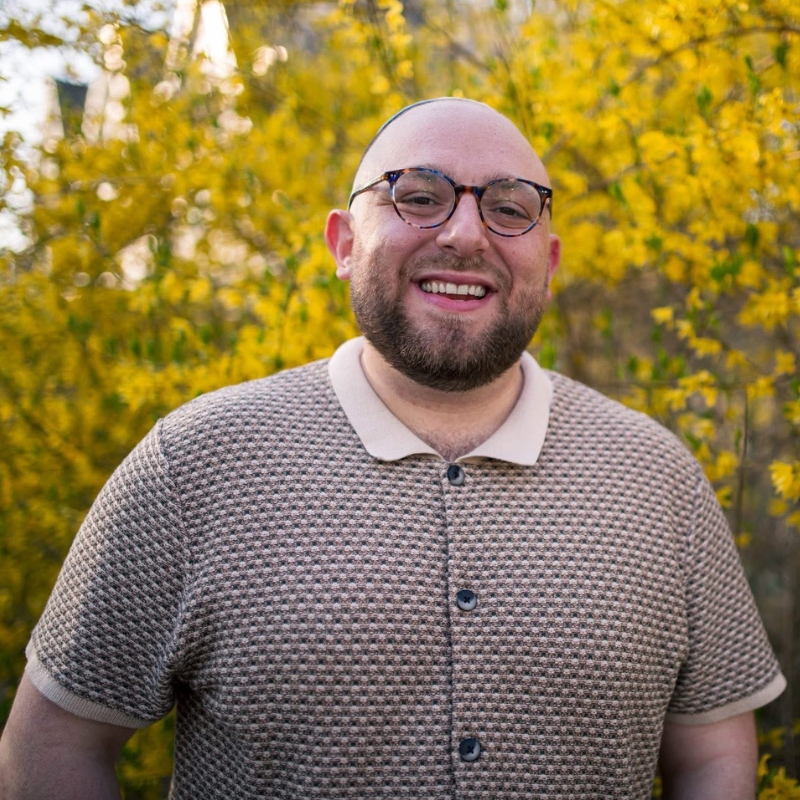
Rafi Ellenson serves as assistant rabbi at Congregation Shir Hadash in Los Gatos, CA. A graduate of the Individualized Bachelor of Arts program at Goddard College, he was ordained by the Rabbinical School of Hebrew College in 2025 and holds certificates in Facilitation from Resetting the Table as well as Interreligious Leadership from the Boston Theological Interreligious Consortium. His creative work can be found in Verklempt!, among other places, and he was the Hebrew translator of “The Little Book of E” by E. Ethelbert Miller (City Point Press, 2024).