
Each year, on the Shabbat prior to Purim, we are commanded to hear a special maftir (final Torah reading) from the book of Deuteronomy (25:17-19):
“Remember what Amalek did to you on your journey, after you left Egypt — how, undeterred by fear of God, he surprised you on the march, when you were famished and weary, and cut down all the stragglers in your rear. Therefore, when the LORD your God grants you safety from all your enemies around you, in the land that the LORD your God is giving you as a hereditary portion, you shall blot out the memory of Amalek from under heaven. Do not forget!”
Even before the horrible massacre of October 7, there has been a stream of Judaism that views all Palestinians as incarnations of Amalek — an ideology that leads to real-world acts of violence against Palestinians. In March 2023, an anonymous Jewish Israeli posted a photo of the village of Huwara on fire. Above the photo, he wrote: “Breaking news: This Shabbat we are going to blot out the memory of Amalek.” And on the photo itself it is written: “Haman they hanged on a tree. Huwara, we will blow up. Happy Purim.” And indeed, a group of Jewish terrorists rampaged through the village that day, burning down businesses and homes, injuring hundreds of innocent people, and murdering one.
Just last week, a Palestinian-American teenager named Nasrallah Abu Siyam was shot and killed, one of hundreds of Palestinians murdered in the last year alone, as some Israelis’ desire for vengeance has lent an unofficial seal of approval to settler violence.
Find more resources on Shabbat Zachor.
It was in this context that I joined a delegation of T’ruah rabbis last November to serve as a protective presence for Palestinians as they harvested olives, pastured their sheep, and simply existed on the land. As has been reported, residents of a nearby Jewish settlement harassed our group of rabbis, activists, and Palestinian olive harvesters with a loud drone. Towards the end of the day, they lowered their drone so close to our group that it badly scraped one of the rabbis. Moments later, two armed settlers approached us, demanding that we return the damaged drone, shouting and shooting live ammo.
The image that stays in my mind the most from that day is the pe’us (curled sidelocks of hair worn by some Orthodox Jewish men) of the settler whose gun was cocked at me. Pe’us are based on a command in Leviticus to not round off the corners of hair on one’s head, nor destroy the corners of one’s beard. (Leviticus 19:27) Like the corners of one’s field, which we are commanded a few chapters later to leave untouched so that people who are poor may eat from them, pe’us serve as a reminder to do justice and help those in need.
And what was this heavily sidelocked man doing? Holding an M16 in the faces of a group of peace activists harvesting olives together. What mitzvah did this allegedly religious man feel that he was fulfilling?
Perhaps he believed that we volunteers were aiding Amalek.
Indeed, his reading of our Torah’s violent rhetoric is understandable. But as rabbinic Jews, we read Torah not only in its own context but also in our own. We look for the ideals that matter in our time, that fit with other ideals that our Torah teaches. Rabbi Samson Raphael Hirsch, the 19th-century founder of the Torah im Derech Eretz movement, writes about these verses: “Do not forget this if you ever waver and, like Amalek, disregard duty, disregard God, and seek only opportunities, in small or great matters, to exercise your superiority to the detriment of your fellow human beings!”
Hirsch continues: “Do not forget this if you ever suffer cruelty and violence yourself. Remain upright! Remain true to the humanity and respect for justice that your God taught you…[H]umanity and justice will remain victorious over cruelty and violence, and you yourself are sent, through your destiny and example, to herald and help bring about this victory and this future.”
In other words, should you ever be tempted to be like Amalek — blot out that very thought. Remember your humanity. Do not forget that to be a Jew is to be a light unto nations, not a threat. Amidst the violence and the pain and the suffering of the world, remember this and aspire to live up to it. Do not forget.
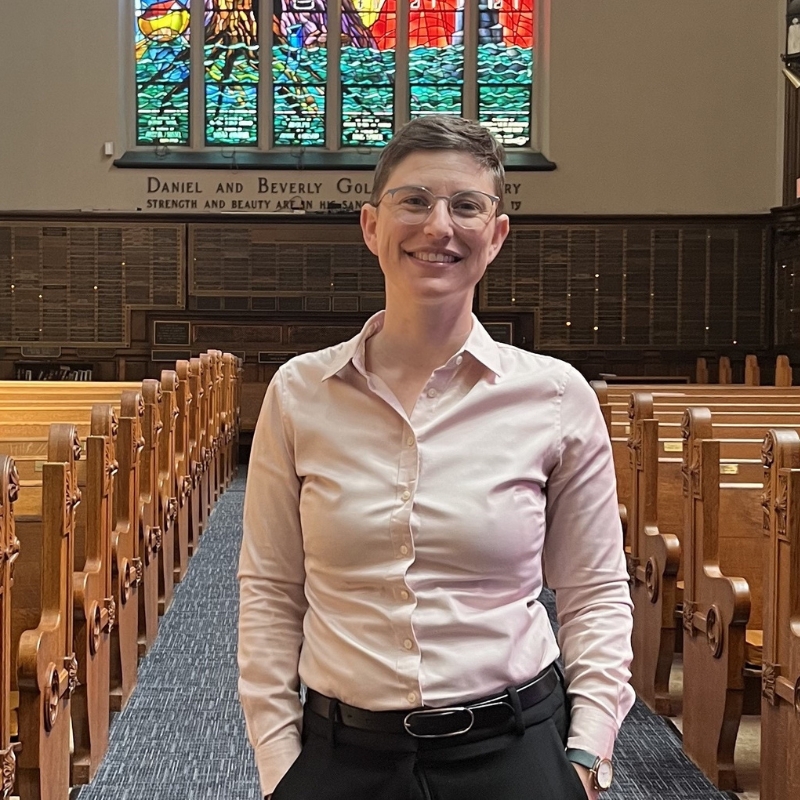
Abi Weber is the associate rabbi at Temple Beth Zion-Beth Israel in Philadelphia, where she has served for the last five years. She is a proud alum of the Jewish Theological Seminary; Avodah: The Jewish Service Corps; Svara: The Traditionally Radical Yeshiva; Moishe House; and T’ruah’s Israel Fellowship. She lives in Center City Philly with her wife, Diana, and their two awesome kiddos.