From the moment he was born, our son Jeremy was not what you would call a stereotypical “boy.” He loved wearing his pink footie PJ’s and washing the floor with his toy mop. He loved watching me put on makeup, and he was obsessed with Disney princesses. When my parents bought him a red Superman cape, he pretended to be the Little Mermaid, with her long flowing red hair, and he adored playing Barbies and American Girl dolls with his sister.
We had no problem with any of this. In fact, we delighted in watching him confidently charting his own path, unabashedly expressing himself, and choosing his own adventures. As he grew, he never seemed interested in following the crowd or conforming to binary expectations. When my husband Richard remarked, “Jeremy, you march to the beat of your own drummer,” he replied, “Daddy, I am my own drummer.”
There’s a lot of marching going on in Parshat Beha’alotecha, and no opportunity to step out of line. The Torah describes, in great detail, the precise arrangement of each tribe as they set off into the wilderness. The 12 tribes were divided into four camps, each camp centered around the Tabernacle and lined up in a divinely dictated order, with Cloud of Glory leading the way to each new destination.
Although uniformity was essential, each tribe was still able to express its individuality. Numbers 2:2 states, “The Israelites shall camp each with his standard, under the banners (d’galim) of their ancestral house…” As described in Bamidbar Rabbah 2:4, these banners, sometimes translated as flags, served to highlight the uniqueness of each tribe:
The Holy One blessed be He loved them with a great love, as he arranged them according to banners like the ministering angels, so that they would be distinguishable. From where is it derived that it was love for Israel? It is as Solomon says: “He brought me to the banquet house, and his banner of love is upon me. ”(Song of Songs 2:4)
These flags were a literal sign of God’s love for the people in all their array, adorned with stones and a bevy of colors:
There were insignias for each and every prince: a banner with a color for each, and every banner like the color of the gems that were on Aaron’s heart, from which the empire learned to make a banner, with colors for each and every banner. For each and every tribe, the prince’s banner was like the color of his stone. Bamidbar Rabbah 2:7
Reuven’s flag was red, Shimon’s, green; Levi stepped it up a notch with a tri-color display of white, black, and red; Dan’s was “like a sapphire,” Naftali’s, the color of red wine. In what can arguably be considered the first Pride flag in history, Benjamin’s flag sported 12 colors, one for each tribe.
Find more resources on Beha’alotecha.
How beautifully appropriate, then, that we read about these multi-colored flags as we welcome in Pride Month. Today, in addition to the iconic rainbow-striped traditional flag, dozens more have been created over the years to represent different sexual orientations and gender identities. There is nothing more energizing and hopeful than walking with hundreds of others in a Pride parade and seeing the myriad of flags held high, a brilliantly hued tribute to the resilience and courage of those who continue to fight for their right to exist.
All three of my adult children identify as LGBTQ+, and growing up queer and Jewish in Texas was not easy. And years later, it’s not only become harder, but also dangerous. Especially for my transgender son, Preston, who no longer feels safe coming home to visit.
In 2025, seven anti-LGBTQ+ bills were passed by the Texas Legislature. Among them, SB8, the Bathroom bill, forces trans individuals to use bathrooms in state public facilities that align with the sex they were assigned at birth.
HB229 strictly defines male and female based on reproductive organs and codifies the 2024 DPS and DSHS policies prohibiting gender marker updates on Texas IDs, driver’s licenses, and birth certificates.
SB 12 prohibits teachers and school staff from assisting students with social transitioning, without clearly defining what that means. And SB1188 requires that electronic health records (EHRs) record a person’s sex assigned at birth as either “male” or “female,” thus enforcing binary sex designations on all Texans, regardless of their gender identity or the status of their legal documents.
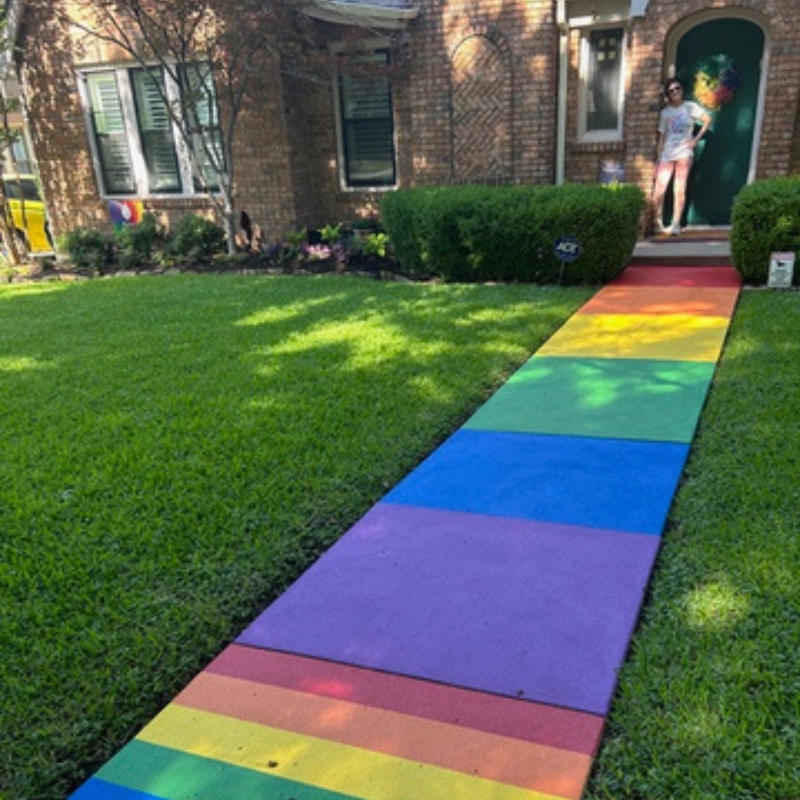
Additionally, Governor Greg Abbott recently issued a directive to ban symbols, flags, or other designs on roadways, including rainbow crosswalks, arguing that it promoted “political ideologies.” Several cities have pushed back, however, boldly painting steps and walkways in rainbow colors. It inspired me to paint the walkway leading up to my home — and so far, I’ve only received compliments!
The aggressive, hostile, and systematic attacks on the LGBTQ+ community in Texas are blatant attempts to terrorize, shame, and dehumanize people who just want to live their lives. Many have already left the state.
Find more resources on LGBTQ+ rights.
But there are many others who have chosen to stay — who refuse to be intimidated or bullied, instead opting to use their voices and growing collective power to stand up to this baseless hatred. As a cisgender, straight woman, I do not encounter the same risks that they do, which makes me all the more determined and driven to stand with other affirming interfaith communities to speak out and take action against this abuse.
Although our testimony and lobbying efforts against the passage of these egregious bills have mostly been ignored, we have come up with creative ways to circumvent them.
Our LGBTQ+ Equality Action Team of Justice Network Tarrant County hosted an interfaith concert, which raised $27,000 for NTTN — the North Texas TRANSportation Network, an organization that provides travel and relocation grants to North Texas families seeking out-of-state healthcare for trans and gender expansive youth.
After the anti-LGBTQ+ legislation was passed, we organized a community forum with panel discussions featuring staff from Keshet, Lambda Legal, and the HELP center for LGBTQ+ Health to educate the community about the ramifications of these new laws, and what people could do to stay as safe as possible.
We have created comprehensive guides that include healthcare, legislative, and community resources for the LGBTQ+ community, and we are currently advocating for the inclusion of single-stall/family restrooms in all public, government-owned buildings.
And of course, during the month of June we show up at Pride events with our swag and our flags, grateful to come together to celebrate, support, and amplify queer joy and the brilliant variations that live within all of us.
So, this year, whether you decide to march to the beat of a different drummer, or to simply be your own drummer, let your freak flag fly. Happy Pride!
Cantor Sheri Allen is the Cantor and co-founder of Makom Shelanu Congregation, an inclusive, affirming synagogue in Ft. Worth, Texas. She is a member of the Cantors Assembly, serves on their Ethics Committee, and is the 2024 recipient of the Yehudah Mandel Humanitarian Award. Sheri is the co-chair of the LGBTQ+ rights committee of the Social Justice Commission of Conservative/Masorti Judaism. Locally, Sheri chairs the LGBTQ action team of Justice Network Tarrant County, is a member of the Inclusive Faith Coalition, a group of LGBTQ+ affirming clergy in Tarrant County, and a member of the Faith and Justice Coalition of Tarrant County, a group of progressive clergy advocating for the rights of all local citizens.