Slichot begins this week, and Rosh Hashanah is just ahead. The Hebrew month of Elul reminds us to enter the Holy Days gently, walking toward them day by day, prayer by prayer, using the tools our tradition provides to do the spiritual work that leads to the Days of Awe.
This summer I’ve been thinking about how to show up well, for myself and for my community. I have the honor this year of stepping into a larger leadership role. My predecessor retired in June, and I was chosen to lead a sweet congregation in my hometown of Toronto. I’m so excited, and yet the transition has been both beautiful and hard. In these first months, I find myself yearning for wisdom on how to lead well.
I’ve found some of that wisdom, unexpectedly, in this week’s parshah, Nitzavim-Vayeilech, where Moses reaches the end of his own leadership journey. He doesn’t step away all at once, taking his time deliberately, and the text shows us how.
Moses names his limit directly: “At this time I can no longer come and go.” (Deuteronomy 31:2)
He doesn’t hide this reality from the people. He tells them directly that God will not let him cross the Jordan (Deuteronomy 31:2), that his death is near (Deuteronomy 31:14), and that he will soon lie with his ancestors. (Deuteronomy 31:16)
Find more resources on Nitzavim.
At the end of a long journey, a leader might feel the pull to defend a record, or offer one last lesson. Instead, Moses tells the people exactly what they need to know to move forward without him. That is accountability, care, and honesty held together. In justice work especially, naming clearly what we can and cannot carry is what lets others step in and lead too.
The lessons on accountability don’t stop there. Moses has already written the Torah and handed it to the priests. (Deuteronomy 31:9) What comes next is something remarkable: “Gather the people, men, women, children, and the strangers in your communities, that they may hear.” (Deuteronomy 31:12)
Every seven years, the whole community gathers to hear the Torah read aloud together. Moses could have handed the Torah to Joshua and called his work done. Instead, he makes sure it belongs to everyone who will need it, including those whose voices are too often left out of the room. Compassionate leadership isn’t only about who leads next. It’s about who gets to hold the text and be heard once you’re gone.
And then Moses receives an instruction that surprises me every time I read it: “Now, write for yourselves this song and teach it to the Israelites, so that this song will be a witness for the Israelites.” (Deuteronomy 31:19)
Find more resources on Social Justice: Leadership and Philosophy.
We might expect Moses to tell the people once more to remember his teachings. Instead, the text says “write for yourselves.” We don’t know exactly what song they were meant to write. I like to think it wasn’t Moses’s song alone, but the song of everyone who lived through that journey, each of them writing their own witness alongside his.
The Talmud teaches that a king writes a Torah scroll for himself, carries it with him, and reads from it all the days of his life. (Sanhedrin 21b) Each of us is given that same charge, to write our own Torah out of the life we’ve actually lived.
Leadership is tender, sometimes lonely, work. That’s why we were never meant to do it alone.
I am living a beginning right now, the way Moses lived an ending. Both are transitions. Both deserve the same compassion and care. Our narrative has been written, but it is not yet sealed, and that is what these weeks before Rosh Hashanah are for. As we enter into these Holy Days, may we lead the way Moses did, naming our limits honestly, making room for every voice in the room, and trusting ourselves enough to write a song that is truly our own, and share it so our world holds more compassionate, caring voices.
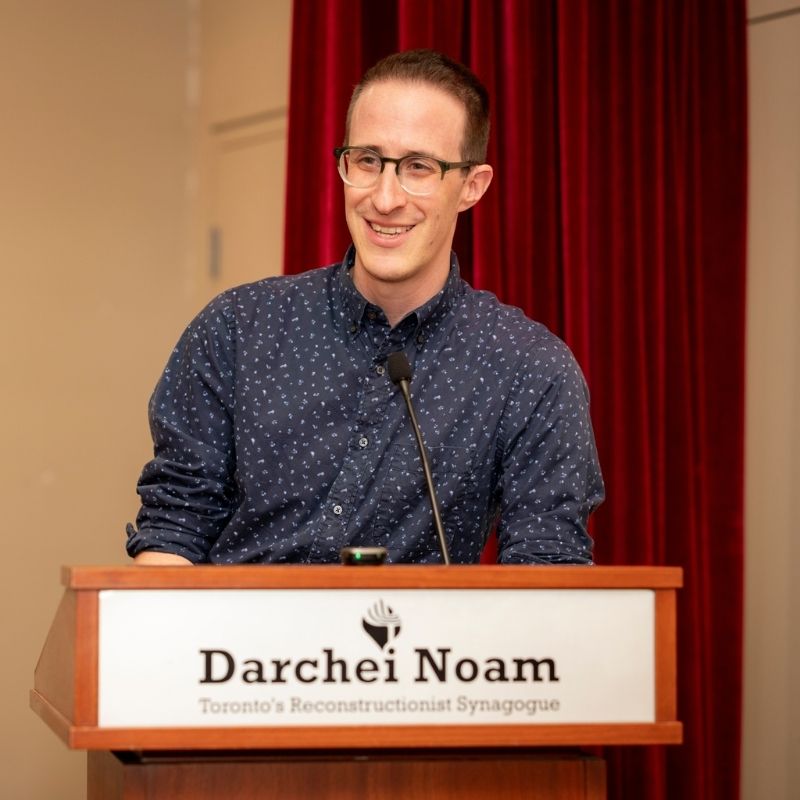
Rabbi Ryan Leszner is honored and proud to serve as the rabbi at Congregation Darchei Noam. Born in Toronto, Ontario, Rabbi Leszner is thrilled to be home after studying as a rabbinical student at Hebrew College, receiving specializations in Pastoral Care and Spirituality & Social Justice Leadership. Rabbi Leszner has a passion for teaching, learning, building bridges, and walking alongside people navigating their Jewish journey. He joyfully shares his life with his partner, Dalia, and his son, Asher.