When sharing a teaching, it’s proper to honor the custom of b’shem omro, which is to give credit to the teacher from whom one learned the teaching. Yet, poor Reb Zusha of Anipoli was never able to honor that custom. The reason is that whenever he would join his fellow students around the tish of their rebbe, the holy Maggid of Mezeritch, he rarely ever got to hear the teaching.
As would typically happen, the rebbe would open with a biblical verse, like: “Vayomer Adonai el Moshe laymor… and God spoke to Moses, saying…,” but could get no further before Zusha fell into a fit of ecstasy, perhaps in astonishment that Moses would have the ability to hear God speak. Or perhaps Zusha was shouting in wonderment that we would have the ability to speak of a God whose essence is beyond words.
For whatever reason, Zusha persisted in crying out, “Vayomer Adonai…Vayomer Adonai…,” “And God spoke…And God spoke…,” making such a commotion that his fellow students had to escort him out of the room. By the time he had regained his composure, they were already on to another topic. Such is the reason that poor Reb Zusha rarely heard the content of his rebbe’s teaching.
Find more resources on VaEra.
There are many things to be astonished about in this week’s Torah portion, VaEra. It could be God’s renewed promises to redeem the enslaved Israelites, or it could be any of the first seven plagues that ensued after Pharaoh’s refusal. But the thing I wonder about most is found in the opening verse, “God spoke to Moses, and said to him, ‘I am YHVH.’” (Exodus 6:2)
God goes on to explain this enigmatic pronouncement by saying, “I appeared to Abraham, Isaac, and Jacob as El Shaddai, but I did not make Myself known to them by My name YHVH.” (Exodus 6:3)
Even the explanation is puzzling. Why would God appear to be making God’s-self known to Moses for the first time as YHVH? The Tetragrammaton, the four-lettered Divine Name, has already appeared 153 times in the book of Genesis, and 24 times in the first five chapters of Exodus. What is new or different now in the way Moses is to understand the words, “I am YHVH”?
Traditional commentators, such as Rashi and Ibn Ezra, suggest that different names represent different attributes. For example, the name “El Shaddai” represents the attributes of One who makes promises, whereas the name “YHVH” represents the attributes of One who fulfills promises.
Kabbalistic and Chasidic interpretations go a step further to suggest that the mysterious four-lettered name is not descriptive like other names, but evocative. Its use in this context implies an altogether new and different way of knowing — not with the mind but with the heart. God is now making God’s-self known in a way that the patriarchs had never experienced.
To understand this different way of knowing, Zusha’s example proves useful. Whereas the primary mode of religious engagement in his day was intellectual study, Zusha’s experience was akin to devekut, a sort of mystical cleaving to God that became a hallmark of early Chasidism. In other words, while his fellow students heard only words, Zusha heard them with a sense of what Abraham Joshua Heschel called “radical amazement,” in which words are no longer just words; they become nothing less than divine utterances.
For many of us today, our primary mode of religious engagement is advocacy and activism, but this parshah calls us into a deeper way of understanding the importance of our work, and a deeper way of hearing any pronouncement that begins with the words, “I am.” Such as…
…I am a refugee. I am an immigrant. I am a person of color. I am a transgender person…
“Vayomer Adonai…Vayomer Adonai…”
…I am a single mother of a disabled child. I am a senior citizen dependent on food stamps. I am a person chronically ill without medical care. I am a child who lost a friend in a school shooting….
“Vayomer Adonai…Vayomer Adonai…”
Whether or not the floodgates of our hearts break open and we are moved to raise our voices in sadness or wonderment, once we regain our composure and return to our sacred tasks, we do so with a sense of radical amazement. As we learn from Moses, our teacher, Reb Zusha, Rabbi Heschel, and others who have encountered this way of knowing, words become more than just words when we know that it was YHVH who spoke them.
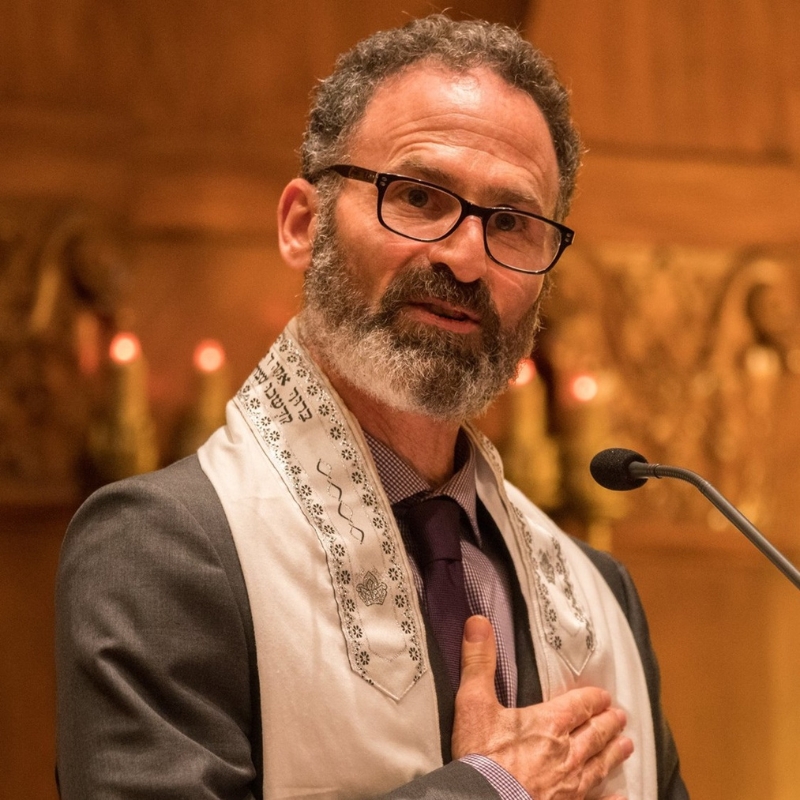
Rabbi Moshe Heyn, D.Div. (he/him) is a surfer, paraglider, hospice chaplain, neo-Chasidic activist, and the spiritual leader of the Coastside Jewish Community in Half Moon Bay, CA.