Eighteen years ago, I stood on the bimah of Congregation Sha’are Shalom in Leesburg, VA, and delivered a d’var Torah about Parshat Emoras I marked my entry into Jewish adulthood. Nestled within Leviticus, Emor starts out by providing Aaron a list of rules for the priesthood to abide by. I remember as a 13-year-old being disturbed by the inherent ableism of the text: People with several different physical disabilities could not serve as priests. While the contents of my d’var Torahremain hazy, I maintain compassion for the younger me, who was tasked with making meaning of a legal code meant for a form of Judaism long past. I also recognize that although reconciling with a problematic text is one way to engage with Torah, my own relationship with Torah has evolved in ways that have led me to seek out less literal interpretations and speak to my own living spiritual questions.
Nearly 20 years later, with decades of life experience, Jewish and Hebrew literacy, and rabbinic ordination, I returned to wrestle with this parshah, this time with a dear chevrutah, Rabbi Jacob Weiss, and the Chasidic commentary of the “Me’or Enayim,” the seminal work of the Chernobler rebbe.
Find more resources on Emor.
In engaging with the introduction of Parshat Emor, the “Me’or Enayim” is quick to expand the subject of the mitzvot from the priesthood to all Jews. He invokes Menachot 110a, which states, “Rabbi Shmuel bar Naḥmani says that Rabbi Yonatan says: These are Torah scholars, who engage in Torah study in every place. God says: I ascribe them credit as though they burn and present offerings to My name.” In other words, through engaging in Torah study, anyone has access to the reward of fulfilling mitzvot assigned to priests.
The “Me’or Enayim” takes his argument one step further. In traditional Jewish teaching, the 613 mitzvot correspond to the combined 613 limbs and sinews of the human body (note: Don’t rely on rabbis for accurate human anatomy). Each human body is comprised of the entirety of the mitzvot, the entirety of the Torah.
I had not fully considered this before. Of course, I knew that there were certain mitzvot I was not able to fulfill. I do not complete the mitzvot related to farming in the Land of Israel. And even if I could trace my lineage to the priestly caste, I have no Temple to perform sacrifices in. And yet, all of Torah is within me. The “Me’or Enayim”says, just as in Bereshit we learn that humanity was made b’tzelem Elohim, in the image of the Divine, that means that we were made b’tzelem Torah, in the image of Torah, of Instruction, of Divine Wisdom.
In conversations with college students participating in Carleton’s Religious Leadership Fellowship, I asked them to consider what specific pathways of leadership they could imagine taking on. We used Deepa Iyer’s Social Change Ecosystem Framework and Rabbi Jill Hammer’s 13 models of the Hebrew Priestess to see which roles spoke most to our gifts and calling.
I brought this live question to my students because, as a rabbi, I have been grappling with what my own role is in justice movements. Living in the Twin Cities and experiencing the horrors of federal occupation and the harm inflicted upon my most vulnerable neighbors, I felt a deep sense of inadequacy as I grappled with how to properly show up.
Surprisingly, I think that those same feelings of inadequacy are related to reading the pieces of Torah that feel most distant to one’s lived experience. There is a desire to do the right thing, to do all of the things, regardless of whether we have the ability to take on those tasks.
The “Me’or Enayim”’s teaching can offer us a sense of wholeness and a sense of purpose. All of Torah is within us, even if we are only able to demonstrate it through a more limited array of actions. The options that we can individually access may be different than our neighbor’s, but no less vital to the project of bringing justice and healing to this world.
We may not be priests, but the “Me’or Enayim,” also gently reminds us that we all have the power to serve God, that the whole Torah is alive within us, and that we, too, can live into the words of Pirkei Avot 1:12: “Be of the disciples of Aaron, loving peace and pursuing peace, loving humanity and drawing them close to the Torah.”
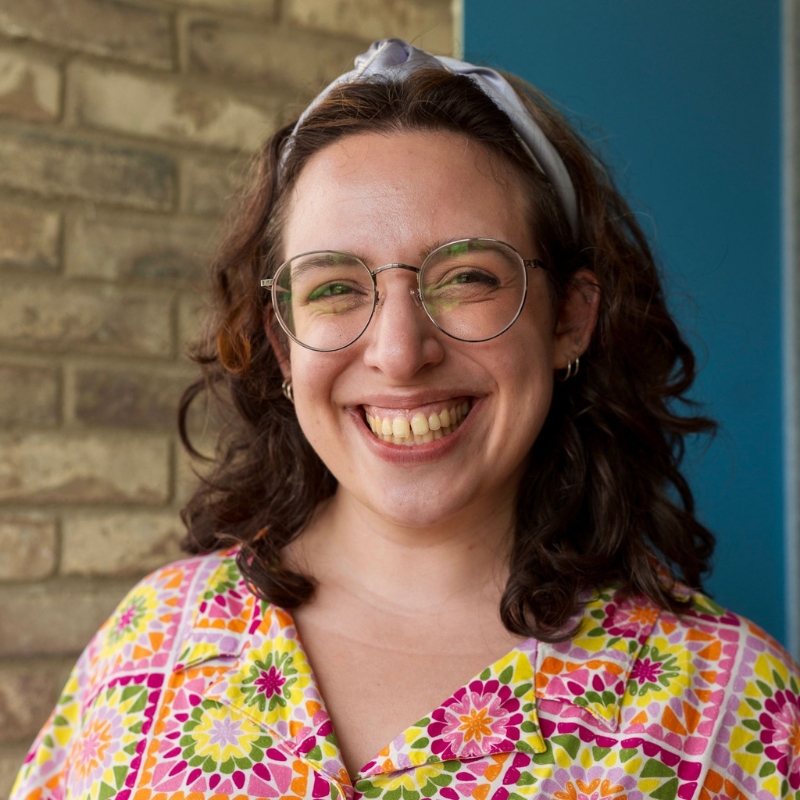
Rabbi Michaela Brown serves as an associate chaplain at Carleton College and St. Olaf College in Northfield, MN. She was ordained by Hebrew College in 2024 and has been involved with T’ruah since participating in the Summer Rabbinical Student Fellowship (z”l) in 2020. She is continuing to seek meaning and community in this new chapter of life, living in Minneapolis!