The word for legal justice in Hebrew is mishpat, the root of which means to decree or judge. And so, it is no surprise that in Parshat Mishpatim, narrative gives way to a compendium of 53 civil and criminal laws dictated to Moses at Sinai. These laws, which examine subjects including slave ownership, personal injury and liability, and property and theft, are the mechanism by which the Israelites are meant to build a functioning society, the continuation of the Ten Commandments which they received on Mount Sinai. And at the end of this list of laws the Israelites respond to Moses with a well-known phrase: “We will do and hear [na’aseh ve-nishma] everything Adonai has said.” (Exodus 24:7) This verse is peculiar as it lists doing before hearing, a seemingly backwards motion, and the rabbis discuss at length why the Torah might phrase the Israelites’ response in this way.
One of the most interesting rabbinic conclusions comes from the 15th century Spanish rabbi Isaac ben Moses Arama, who notes that the word nishma, commonly translated as “we will hear,” can also mean “we will understand,” changing the verse to: “We will do and understand everything Adonai has said.” This interpretation seems to imply that for the Israelites to truly understand the moral and ethical implications of God’s commandments, they must first experience them.
Find more resources on Mishpatim.
American psychologist Lawrence Kohlberg famously taught that moral development, the ability to distinguish right from wrong, occurs in six distinct stages, with the final three being the most significant. The fourth stage of moral development is maintaining the social order, in which laws and regulations, not unlike those in Parshat Mishpatim, are followed and obeyed without question. The fifth stage focuses on individual rights, challenging every human being to consider what makes for a good and just society. And the final stage is that of universal ethics, in which moral reasoning is based on personal values. This stage acknowledges that elected processes do not always result in just outcomes, and that universal ethics, such as equity, justice, dignity, and respect, must form the bedrock of what is right and what is just. Laws and rules are only effective if they uphold these principles, and that can only be determined at this final stage, after those rules have been experienced.
Kohlberg understands that to achieve a society built upon universal ethics, we first have to experience a society of law. In other words, to fully understand, we must first do. But he also recognizes that after experiencing and understanding the laws present within our society, we may find that they do not represent the values we claim to hold. That in fact they protect the powerful at the expense of the vulnerable, vilify the abused while shielding the abuser, silence the oppressed while awarding the oppressor, divide rather than unite. And in that case, those laws require revision.
an instrument of the other. But in a time when the killing of unarmed Americans by federal law enforcement is administratively justified, in a country that prioritizes expansionism over international law, in a society that too often prioritizes profit over human dignity, law and justice have become anything but synonymous.
We must ask ourselves whether the laws of our nation truly embody the universal principles of equity, justice, dignity, and respect, and help us to build a society worthy of the people who live here. And if they do not, then our task is not blind obedience but moral courage.
Torah does not ask us to confuse legality with righteousness. It challenges us to investigate whether our laws serve the most vulnerable, honor human dignity, and reflect the divine spark that exists within every human being. When law and justice drift apart, our obligation is to work to bring them back into alignment, so that our world might embody what we know to be right.
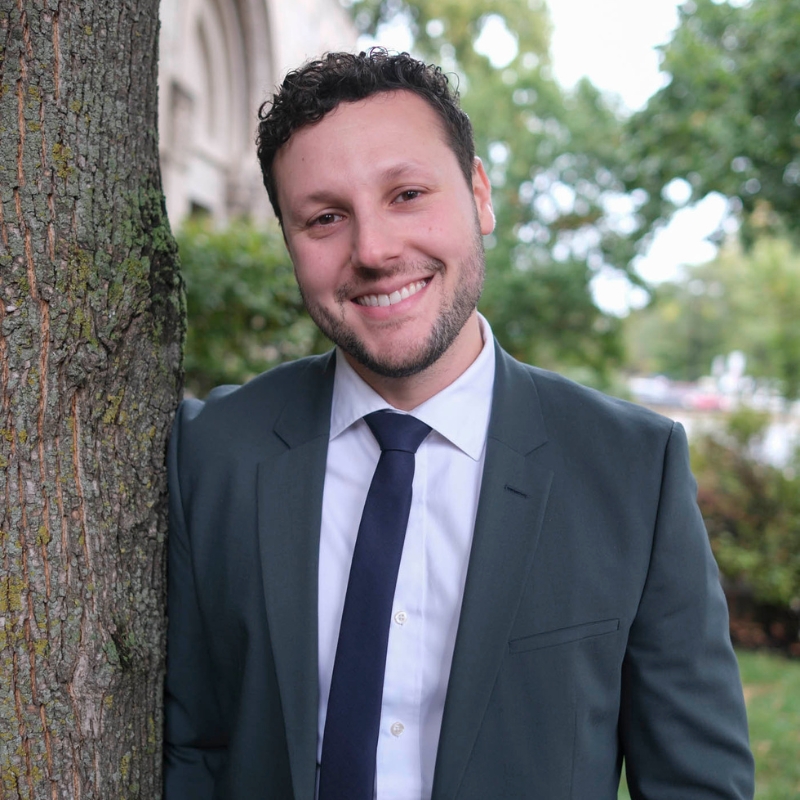
Rabbi Max G. Antman (he/him) is on the rabbinic team at Temple Sholom of Chicago, where he works to bring Torah, justice, and spirituality to students of all ages. Rabbi Antman holds a B.A. in political science from the University of Illinois at Urbana-Champaign and received his rabbinic ordination from Hebrew Union College–Jewish Institute of Religion in Los Angeles, where he also completed a certificate in Jewish organizational leadership. During both his first and third years of rabbinical school, Rabbi Antman served as a rabbinic intern at T’ruah, and remains a passionate member of T’ruah’s chaverim network today.