While accompanying synagogue members and hospital patients at a loved one’s death bed, I have witnessed declarations of love, hopes for the future, and the passing on of legacy. There is always an attempt at saying one more word, a desire to say one more sentence that could convey what the other person has meant, what their life has meant. Each of these experiences is both extremely unique to each person and each family and is also universal, as we will all eventually experience that moment, hopefully surrounded by loving family and friends.
This week’s Torah portion, Vayechi, recounts Jacob’s final moments of life. Reading it, I was struck by how lucky Jacob is to gather his family around him. He “assembled [his sons] with the Divine Spirit.”(Bereshit Rabbah 98:3) Jacob knows this moment is important and holy. He wants them around him to make sure they know how he feels about them. They have hardly had easy relationships, but ultimately, he wants to be honest with them, to explain what it has meant to him to be their father. If he is not going to be honest now, then when? Though it is rarely easy to speak or hear hard truths, true engagement requires honesty, and this, too, can be an expression of love. Jacob’s final words teach us that honesty and interconnectedness are essential, even in moments of pain.
Find more resources on Vayechi.
What Jacob recites, though, is a challenging and dense 25 verses that are a mix of blessings and what seem to be curses as he addresses each son individually. To Judah, he says, “You, O Judah, your brothers shall praise; your hand shall be on the nape of your foes; your father’s sons shall bow low to you.” (Genesis 49:8)
Judah’s enemies and his brothers are mentioned in almost the same breath, blurring the line between kinship and conflict. The words used are also quite similar: oyvecha (your enemies) and bnei avicha (your brothers). What are we to make of this? Are our brothers really our enemies, and are our enemies actually our brothers?
Depending on a variety of circumstances, there are times when those whom we may perceive to be outsiders are our allies, and there are also times when those who are our brothers could not feel further away. Thinking of people as outsiders or as others is, of course, permissible, but perhaps Jacob is trying to convey that we are obligated to them nonetheless. In our current moment, we are extremely quick to name someone as our enemy and to keep them there. But perhaps we need to be open to dynamics being able to shift: Those we perceive as enemies could actually be our allies. I would be hard-pressed to think of a more meaningful deathbed lesson to impart.
It is all too easy to dismiss the pain of others, to say that I do not need to care about someone who is not my brother. That is the opposite of Jacob’s message, though. “When suffering has hardened our hearts,” writes Rabbi Susan Talve, “we have forgotten that our lives are all connected, one soul bound up with the other…”
Earlier in Jacob and Joseph’s story, Joseph overhears Judah suggesting that if something were to happen to his brother, Benjamin, Jacob would surely die because his “soul is bound up with his.”(Genesis 44:30) Joseph’s heart then opens to forgive his brothers despite being in a moment of great despair. Even amidst deep pain, we can bless those around us by rejecting self-interest and working for the common good, embracing harmony and a vision of the world as it could be.
In the end, Jacob’s words remind us that life’s most sacred moments call us to speak truth and to recognize our deep ties with one another. Even when relationships are fraught, even when pain tempts us to turn away, we are bound together. If we can embrace that truth, then even in the shadow of death, we can choose blessing and connection and create a world where even former enemies can become brothers.
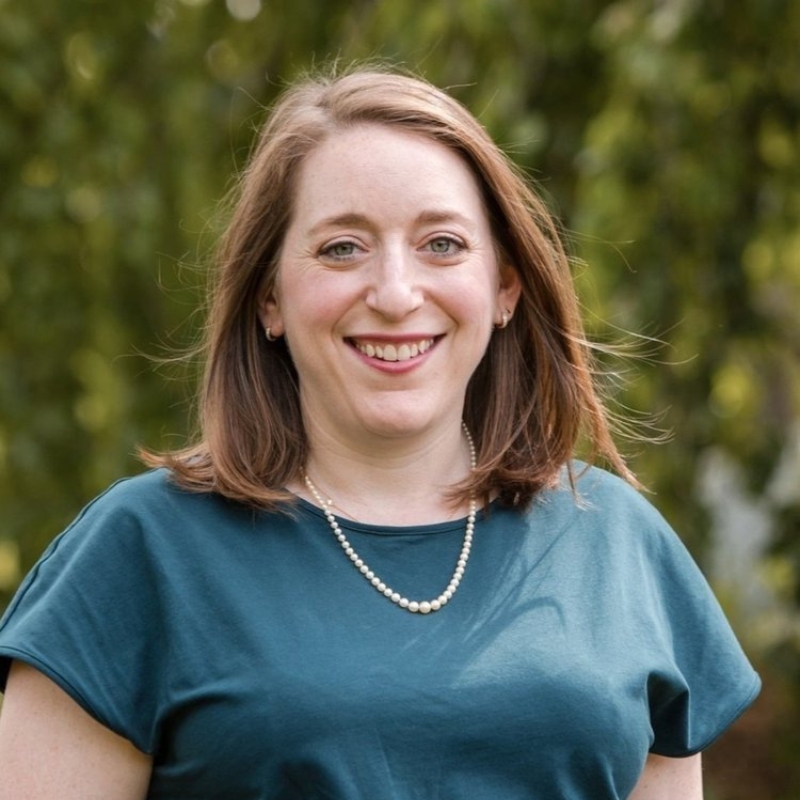
Rabbi Hannah Ellenson is the director of congregational engagement and innovation at Temple B’nai Jeshurun in Short Hills, NJ. She was ordained at Hebrew Union College in New York in 2025 and received an MPP from Tel Aviv University with a focus on conflict resolution and mediation in 2011. Hannah currently lives in Maplewood, NJ, with her spouse and two kids and is a board member of T’ruah: The Rabbinic Call for Human Rights. Human Rights.