There is a well-known (and slightly strange) tale in the Babylonian Talmud, Brakhot 5b:
Rabbi Hiyya bar Abba became ill, and Rabbi Yohanan came to visit him. Rabbi Yohanan said to him: “Is your suffering beloved to you?” He replied, “They are not, and neither are their rewards.” Rabbi Yohanan said, “Give me your hand.” Rabbi Hiyya bar Abba gave him his hand, and Rabbi Yohanan lifted up Rabbi Hiyya bar Abba.
Rabbi Yohanan then became ill, and Rabbi Hiyya bar Abba came to visit him. He said to him, “Is your suffering beloved to you?” He replied, “They are not, and neither are their rewards.” He said to him, “Give me your hand.” Rabbi Yohanan gave him his hand, and Rabbi Hiyya bar Abba lifted him up.
Why did Rabbi Yohanan not just lift himself up? Our Rabbis teach, “A prisoner cannot free himself from a prison.”
Each of us has had situations, perhaps quite a few, in which we relied on the support of others to get us through a tough time. But it is nearly impossible for me to read this vignette without thinking about my experiences praying and learning with people in custody on Rikers Island. As the rabbi of Base UWS, I value that we are a part of the New York Jewish Coalition for Criminal Justice Reform (NYJCCJR). Through this initiative, we visit Rikers Island each month to pray and learn with the Jewish community in custody.
We learn a great deal about a society by how we treat people on the margins. Whether it be those who are incarcerated, unhoused, food insecure, or socially isolated, how we treat our most vulnerable is an expression of our values.
Rikers Island is a dump — there is no way around it. As a pre-trial jail, people in custody are expected to settle there while they await their sentences, and I have met individuals who have been at Rikers for years as they await their court dates. People in custody do not have control over their time or connections with the outside world. And yes, Rikers Island is actually built on top of a garbage dump that releases toxic chemicals.
Find more resources on Chanukah.
Despite all of this, the holiness that I sometimes glean on Rikers Island has become a common occurrence. My first visit was during a Chanukah celebration two years ago with about 100 people in custody, alongside other volunteers from the Jewish Community Relations Council and Chabad. There were beautiful sufganiyot (jelly donuts), dancing, magicians, fire juggling (not sure how this was allowed), and the delicate balance of joy and despair as we celebrated a joyous holiday in a broken place.
I immediately thought about the brilliant words of the Rebbe of Kohznitz in the “Avodat Yisrael,” where in his homily on Chanukah, he stresses that the holiday lights are not actually for us, but for those on the outside:
Our sages hint that it is not enough that a person draws the illumination of Chanukah only for himself. Rather you should cause the divine flow to illuminate for your entire household, so that everyone can be inspired by the Chanukah light to serve God in love and awe…
… And further they teach in the Talmud, “You should rest the lights at the entrance of your house on the outside.” Everyone who can light should, because the light that is kindled on Chanukah draws holiness for those on the outside. For we know that there are those on the “outside” who cannot obtain holiness. Therefore, we should enlighten everyone so that they recognize that God alone rules everything. (Shabbat 21b)
The essence of Chanukah is to bring the holiday lights to those outside of our homes. Whether we are lighting one candle each night or many, the Chanukah lights are intended for people on the “outside” — those on the margins. The internal practice of Chanukah is to turn outward and examine how we help illuminate God’s holiness for people on the outside of our society.
It goes without saying that those shackled by our criminal justice system are some of the most forgotten in our communities. A person has no ownership over their time, and visiting Rikers Island is a trip in itself. New York City law has mandated Rikers Island’s closure by 2027; four borough jails will sit in its place, and though plans for this transition are severely delayed, many are still optimistic. While this will not solve all of our issues in the criminal justice system, it will hopefully help ease a bit of the isolation and allow easier access for loved ones and lawyers to visit people in custody. Of course, there is still much more work to be done.
With each of my visits to Rikers Island, I am inspired by the yearning for teshuvah, returning to the best versions of ourselves, and the love of God that is expressed. With much of our criminal justice system stacked against people in custody, the self-determination and responsibility present is unexpected. It is a common occurrence to talk with folks who are working on becoming more honest, humble, and loving — qualities that many of us strive for each day.
Along this journey, God is a rock of comfort, security, and hope for many. There is a great desire to learn about Torah and to feel connected to something bigger than oneself. It may sound bizarre, but God’s love is often palpable when congregating with others on Rikers Island. It is a reminder that we are always loved by God, no matter how far we fall or what mistakes we make. These are very real-life Rabbi Hiyya bar Abbas and Rabbi Yohanans lifting each other up.
May the Chanukah lights be a symbol for the ways each of us can spread love and righteousness to others. And may they inspire a justice system for our society that is led by true love and righteousness.
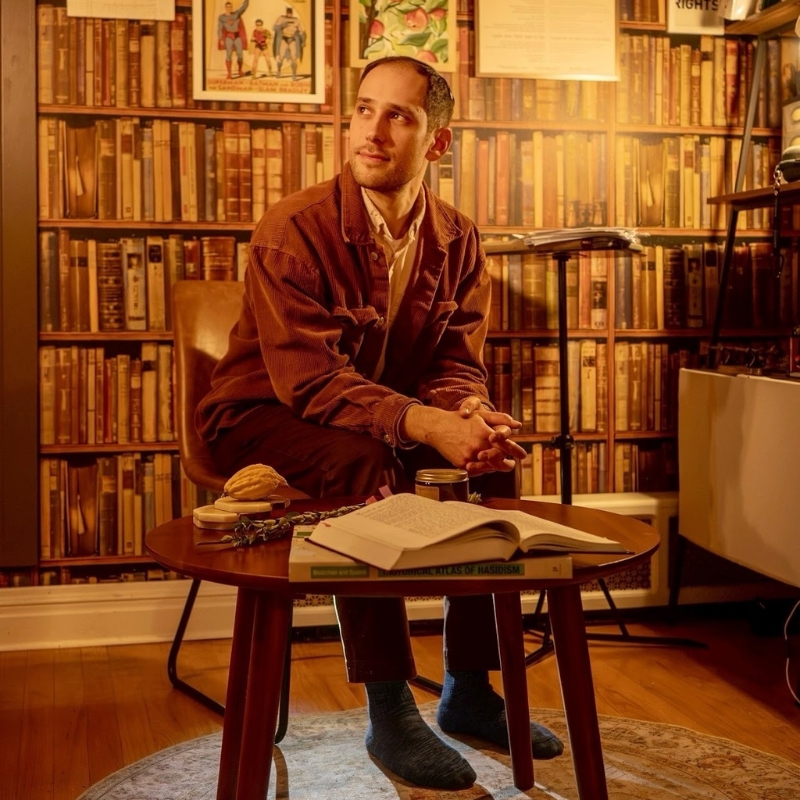
Danny Stein is the rabbi of The Selma and Lawrence Ruben Base UWS in New York City, working alongside his wife Tamara. He is deeply passionate about helping others connect with Judaism in authentically meaningful ways and building a pluralistic Jewish community through Torah, justice and compassion, soulful prayer, and stimulating conversations. You will most likely find him studying a chasidic text, (re)watching “The West Wing,” or eating sushi. Danny received his rabbinic ordination from Hebrew College in Boston in 2023 and is a former T’ruah Summer Fellow.