In this week’s double portion, Parshat Behar-Bechukotai, we read about the jubilee year. Great emphasis in our Torah portion is placed on our relationship with the land. Notwithstanding that the obligations attendant to the jubilee year have never been observed, our contemporary understanding is often placed within an ecological context: Our role is to be stewards for G-d’s created land.
However, rather than simply focusing on the status of physical land, the greater message of the jubilee year is one of freedom for everyone, for all the land’s inhabitants. In Avigdor Bonchek’s “What’s Bothering Rashi? A Guide to In-Depth Analysis of his Torah Commentary,” he explores the deeper meaning of the verse:
You shall sanctify the fiftieth year and you shall proclaim freedom throughout the land for all its inhabitants; it is a jubilee year for you and you shall return each man to his heritage, and you shall return each man to his family. (emphasis added) (Leviticus 25:10)
Bonchek focuses on an interpretation of freedom prescribed by the jubilee year that is not solely connected to land. The freedom to be attained is for each and every individual, and is not reliant on actual ownership of land. Nehama Leibowitz, in her commentary “New Studies in Vayikra,” focuses on the use of the word d’ror rather than chofesh. According to Leibowitz, chofesh implies only freedom from servitude, whereas d’ror signifies the complete abolition of enslavement. She goes further in framing this sense of freedom as both an opportunity and an obligation to possess a sense of freedom that allows us the choice to live our lives with a higher purpose. We move from the freedom from servitude we celebrated on Pesach, toward the freedom we choose for ourselves when we stand at Mt. Sinai: the freedom to be in covenant with G-d in order to serve a higher purpose.
Find more resources on Behar.
That the jubilee year is about freedom is made clear through further commentary. Quoting Martin Buber, Nehama Leibowitz, says, “G-d allows fateful misfortune free rein to strike at those who yearn for freedom but do not grant it to their fellow.” Rabbi Jacob Staub, in his d’var Torah on Parshat Behar, observes that Parshat Behar seeks to subvert economic and social hierarchies, and that just as we cannot allow ourselves to be oppressed, we have no right to oppress others (source: “Neither Oppress nor Allow Others to Oppress You,” in “Torah Queeries”). I would add to Staub’s words that we are obligated to fight for anyone who is deemed “other” and is subject to oppression.
I thought about all this, reflecting on my experience in Minneapolis on a very cold January day. We gathered as part of a broad clergy calling to let the people of Minnesota know that, while they were under siege by ICE, they were not alone. While it was awe-inspiring to be among the 75,000 marching in the streets of the city, and standing in the Target store to demand they cease cooperating with the cruel and illegal actions of ICE agents, my greater memory and most important learning came in a morning spent in the neighborhood where both Renee Good and George Floyd were murdered. (Alex Pretti would be murdered the day after I came back home to Kansas City. Renee Good had previously lived here in Kansas City.)
The neighborhood is really a community of four neighborhoods centered around George Floyd Square. Before touring this special community, I gathered with other rabbis at the Calvary Lutheran Church to receive an introduction to the community organizing work that started after George Floyd’s murder, and that continues in response to ICE and other issues that threaten the welfare of the community. We had the privilege of meeting Marcia Howard, a leading organizer and activist.
Her moving words connected me to this week’s parshah with the simple phrase “take back our streets!” I recalled this demand as I read about the return of land in the jubilee year and what it means to retake and preserve a sense of community. Put another way, how do we work toward a sense of communal connection on the streets where we live, streets that are free from the threat of violence by a rogue ICE goon squad that operates under the guise of government authority?
Marcia Howard has an answer. She is a fixture in the community. She is a high school English teacher, president of the teachers’ union, and a retired Marine. She holds meetings twice daily outside of an abandoned gas station. The community celebrates its vast diversity as a strength. Everyone knows everyone, and everyone greets everyone. They provide mutual aid for people fearing ICE abductions, which were active and ongoing at the time.
Let us take the lessons of the jubilee year, and the example of Marcia Howard and so many others who stand with and fight for those under attack for being other, by lifting up diversity as our great strength and bringing together all communities who are marginalized and oppressed. Let us work toward what is yet to be realized, a true jubilee year with true and lasting freedom for all people.
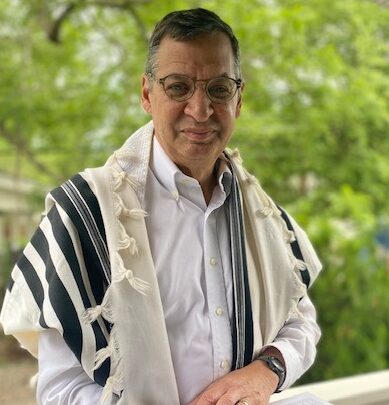
Doug Alpert is the rabbi at Congregation Kol Ami, Kansas City’s Urban Progressive Synagogue. He serves on the boards of the Missouri Conference of the NAACP, Planned Parenthood Great Plains, Missouri Jobs with Justice, Missouri Faith Voices, Missouri Workers Center, and the Migrant Farmworkers Assistance Fund. He has been a speaker in Kansas City at the Women’s March in 2017, the recent No Kings Rally, and for the Palestinian American Medical Association.