A gentle breeze passes through Jacob’s thinning hair as he sits by the Jabbok River, alone and searching for the small jars of his youth. His family and possessions are already across; he lingers behind, uncertain of his future and fearful of Esau’s wrath.
Jacob’s life is marked by struggle — running, bargaining, wrestling. Yet here, at night by the riverbank, he faces his most mysterious opponent.
The Torah tells us: “Jacob was left alone. And a figure wrestled with him until the break of dawn.” (Genesis 32:23)
This is no ordinary encounter. Jacob wrestles with something — or Someone — beyond himself. The classic rabbinic commentators debate the nature of this struggle. Was it physical, or spiritual? Did Jacob wrestle with an angel, Esau’s guardian, or perhaps his own inner turmoil? The word vayē’avek (wrestled) comes from avak, meaning “dust.” As Rashi notes, their struggle lifted up dust towards heaven. The image is both earthly and divine, capturing what it means to be human: to wrestle with God in the dust of life.
Jacob, the bargainer and heel-grabber, who has somehow always seemed to maneuver his way through conflict, now meets a challenge he cannot outwit. The match ends in a draw. Wounded but unbroken, he refuses to let go without a blessing, a blessing which shifts his fortune.
“Said he, ‘Your name shall no longer be Jacob, but Israel, for you have striven with beings divine and human, and have prevailed.’” (Genesis 32:29)
Jacob becomes Yisrael — one who wrestles with God. Rashi teaches that from this moment on, Jacob’s blessings come not through shrewdness or deception, but rather through honesty and integrity. The new name marks not just a new identity and title, but a new way of being, bringing together the pieces, broken and whole.
Jacob limps into the dawn carrying both pain and blessing, injury and insight. His struggle remains unresolved, and that may be the point. The Netziv teaches that “both of them prevailed.” Jacob’s limp becomes a sign of faith — a reminder that encountering the Divine can leave us changed, even wounded, yet ultimately strengthened.
Find more resources on Vayishlach.
To be Am Yisrael — the People of Israel — is to inherit this identity. We, too, are God-wrestlers. Rabbi Arthur Waskow z”l called us “Godwrestlers” not because we defy God, but because we engage — refusing complacency, grappling with the moral and spiritual questions of our time. Our tradition is not one of sheer acceptance but of courageous engagement: wrestling with Torah and our values as we work alongside our partners, neighbors, and family, confronting the absence and striving to bring the Divine Presence into our world.
In this moment, when our communities carry fear, grief, and uncertainty, this identity of wrestling feels especially urgent. Wrestling is a powerful metaphor for faith. It is intimate, demanding, and requires courage and persistence. To wrestle means to hold on — even when understanding feels out of reach. Jacob’s night by the Jabbok becomes our metaphor: Faith lives in the tension between the darkness and dawn.
Jacob’s strength lies not in perfection but in persistence. He doesn’t flee the struggle; he stays in it until the light breaks through. That, too, is the story of our people. Across generations, the Jewish people have wrestled with exile, persecution, questions of justice, and moments of despair — yet we have never stopped striving toward hope, purpose, and covenant.
Our resilience, like Jacob’s, is born from our willingness to engage: to ask, to question, to hold on. As Am Yisrael, we are called to continue this sacred wrestling — to seek God’s presence, to confront brokenness with compassion, and to live our questions with integrity and faith.
Jacob’s night by the Jabbok reminds us that blessing is often found within struggle, that faith can coexist with doubt, and that wrestling with God is not a mark of weakness but of a deep relationship. May we embrace this sacred identity — to wrestle, to strive, and to hold on until the dawn reveals new light.
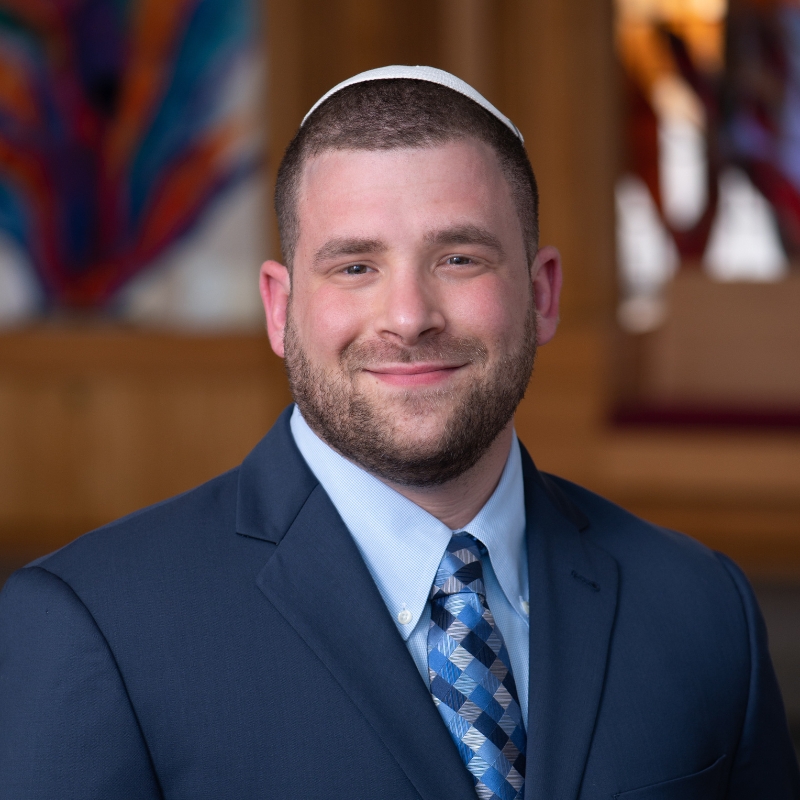
Adam Gillman (he/him) is an educator, a hospital chaplain, and a rabbi. He was ordained by the Jewish Theological Seminary in 2023, where he also earned an MA in Jewish Education. He currently lives in New York City with his wife, where he serves as a chaplain resident at the VA. He is a former T’ruah Summer Fellow.