
Text Study
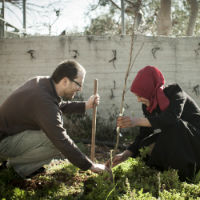
Yovel Text Study: Return
The Jewish mystical tradition offers depictions of periodic cosmic rebirth, in which every 50,000 years, the entire universe returns to its original state. This can be seen as a more mythic, cosmic version of a the radical notion of land-return in our earthly yovel, the biblical commandment in which every fifty years, land would return...
more

Yovel Text Study: Make the Year Holy
In The Sabbath, Rabbi Abraham Joshua Heschel famously frames Jewish perceptions of holiness as holiness in time rather than in space: “The quality of holiness is not in the grain of matter. It is a preciousness bestowed upon things by an act of consecration and persisting in relation to God.” He describes Shabbat as a...
more

Yovel Text Study: D’ror (Liberation)
In the yovel year, the enslaved go free; the Hebrew word d’ror refers to this release, and to liberty itself. Perhaps the most famous use of Leviticus 25:10 is on Philadelphia’s Liberty Bell, on which is enscribed: “Proclaim LIBERTY throughout all the land unto all the inhabitants thereof”. The iconic bell was created for the...
more
Yovel Text Study: 50 Years
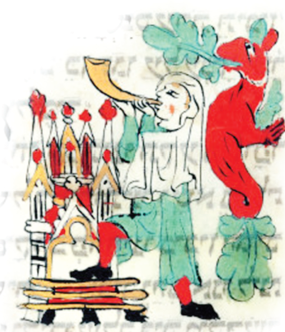
We don’t know exactly when the Yovel year begins. It’s the culmination of seven cycles of seven years, each culminating in a sh’mitah—sabbatical—year. The only way to arrive at Yovel is to count seven years, then seven again and again until forty-nine years have gone by. Similarly, the Torah never tells us precisely when to...
more
Yovel Text Study: Betach (Security)
Imagine the time leading up to the sh’mita year in the ancient world. In an agricultural society, people no doubt would have been anxious: what would they eat while the land rested? Would the previous season’s crop suffice for an extra year? And before the yovel year, the anxiety must have been doubled, as the produce of the forty-eighth year would have to last for two extra years! This passage in Leviticus acknowledges this fear, and also frames the yovel year as a time to cultivate a sense of security not based on material possessions.
more
Yovel Text Study: The Land Is Mine
Each yovel—the last year of a fifty-year cycle—returns the entire land to its original owners. What might be described as radical land reform aims to prevent the development of a permanent underclass, but beyond this, expands our consciousness to understand that land is fundamentally not for sale, that on some level the entire earth belongs to God and never really to us.
more
Yovel Text Study: Jerusalem
While this series focuses primarily on yovel as a source of wisdom for how to approach the fiftieth anniversary of the Six Day War in 1967 and its aftermath, our project would not be complete without engaging with Jerusalem itself.
more

Words Can Kill
A text study for considering the impact of violent speech, in political discourse or otherwise.
more
A Plan Devised Against Them: Oppression and Justice, Then and Now
A brief text study about the systemic nature of racial oppression, with thanks to Rabbi Michael Rothbaum.
more